
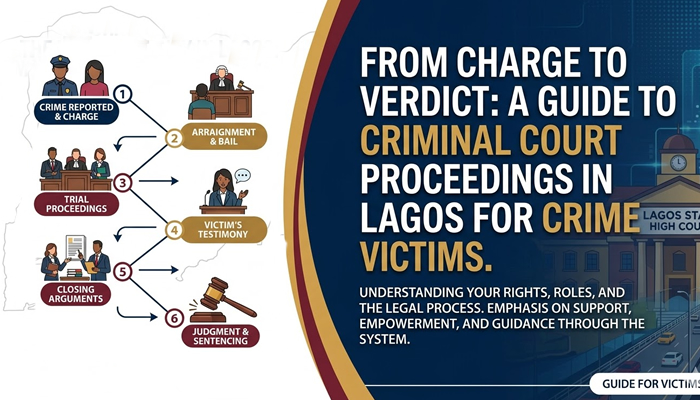
If you are a victim of crime and a suspect has been arrested and charged, you may find yourself drawn into a court process that feels unfamiliar and intimidating. Understanding how criminal proceedings work in Lagos can help you know what to expect, protect your interests, and ensure that your voice is not lost in the process. This guide explains the key stages of a criminal trial in Lagos State.
Stage 1: Arrest and Charge
Once a suspect is arrested, the police have a defined period under the Administration of Criminal Justice (Amendment) Law 2021 within which they must either charge the suspect in court or release them. For serious offences such as murder, robbery, or rape, the suspect must be charged before a magistrate or High Court within 24 to 48 hours, or brought before a court for remand. As a victim, you have the right to be informed when a charge is filed.
Stage 2: Arraignment and Plea
Arraignment is the first formal court appearance, during which the charge is read to the accused and they enter a plea of guilty or not guilty. If the accused pleads guilty, the court may proceed immediately to sentencing. If they plead not guilty, a trial date is set. Victims are entitled to attend court proceedings and are encouraged to do so where it is safe and appropriate. CVS&R Foundation can accompany you to court if you need support.
Stage 3: Trial — Prosecution and Defence Cases
At trial, the prosecution presents its case first, calling witnesses and tendering evidence. The defence then responds, presenting its own witnesses and cross-examining the prosecution’s witnesses. As a victim, you may be called as a prosecution witness to give evidence about what happened to you. You are not required to act as a lawyer — the prosecutor will guide you through this. What you are required to do is tell the truth as clearly and accurately as you can recall it.
Stage 4: Judgment and Sentencing
After hearing all the evidence, the judge delivers a judgment. If the accused is convicted, the court proceeds to sentencing, which may take place on the same day or at a later date. If the accused is acquitted, they are discharged. Either party may appeal the decision to a higher court. Victims have the right to be informed of the outcome of the trial and of any subsequent appeal proceedings.
Delays in Court Proceedings
It is important for victims to be prepared for the reality that criminal trials in Nigeria can take considerable time to conclude. Cases are often adjourned multiple times due to witness unavailability, defence applications, or court scheduling pressures. The Administration of Criminal Justice (Amendment) Law 2021 introduced provisions aimed at reducing these delays, including day-to-day hearing requirements for criminal trials. CVS&R Foundation can help you follow up with prosecutors and monitor the progress of your case throughout this period.
CVS&R Foundation can accompany you to court, help you understand proceedings, and liaise with prosecutors on your behalf. Call 0708 355 7671 or visit www.cvsandrfoundation.org.